Device catalog
Every device has a story
Specs, variants, and the repair ecosystem around each device — from the platform built on verified repair records.
-
 Atari 2600 The Atari 2600 is a home video game console developed and produced by Atari, Inc. Released c. September 1977 as the Atari Video Computer System, it popularized microprocessor-based hardware and games stored on swappable ROM cartridges, a format first used with the Fairchild Channel F in 1976. The VCS was bundled with two joystick controllers, a conjoined pair of paddle controllers, and a game cartridge—initially Combat and later Pac-Man. Sears sold the system as the Tele-Games Video Arcade. Atari rebranded the VCS as the Atari 2600 in November 1982, alongside the release of the Atari 5200.
 -
 Atari 5200 The Atari 5200 is a home video game console introduced in 1982 by Atari, Inc. as a higher-end complement for the popular Atari Video Computer System. The VCS was renamed to Atari 2600 at the time of the 5200's launch. Created to compete with Mattel's Intellivision, the 5200 wound up a direct competitor of ColecoVision shortly after its release. While the Coleco system shipped with the first home version of Nintendo's Donkey Kong, the 5200 included the 1978 arcade game Super Breakout, which had already appeared on previous Atari home platforms.
 -
 Atari 7800 The Atari 7800 ProSystem, or simply the Atari 7800, is a home video game console released by Atari Corporation in May 1986 as the successor to both the Atari 2600 and Atari 5200. It can run almost all Atari 2600 cartridges, making it the first console with backward compatibility. It shipped with a two button controller, instead of the 2600-standard Atari CX40 joystick, and with Pole Position II as the pack-in game. The European model has a gamepad instead of a joystick. Most of the early releases for the system are ports of 1981–1983 arcade video games.
 -
 Atari Jaguar The Atari Jaguar is a home video game console developed by Atari Corporation and released in North America in November 1993. Atari marketed it as the world's first 64-bit game system, drawing controversy as some argued that this configuration did not meet the definition of a 64-bit system. The Jaguar launched with Cybermorph as the pack-in game. A total of 63 licensed games were released for the system prior to its discontinuation in 1996.
 -
 Atari Jaguar CD The Atari Jaguar CD is a CD-ROM peripheral for the Atari Jaguar video game console. Only 11 games were released for the Jaguar CD during its lifetime. However, previously unfinished and homebrew games have since been released.
 -
 ColecoVision The ColecoVision is a second-generation home video game console developed by Coleco and launched in North America in August 1982. It was released later in July 1983 in Europe by CBS Electronics as the CBS ColecoVision.
 -
 Vectrex The Vectrex is a vector display-based home video game console, the only one ever designed and released for the home market, that was developed by Smith Engineering and manufactured and sold by General Consumer Electronics. It was first released for the North American market in October 1982 and then Europe and Japan in 1983. Originally produced by General Consumer Electronics, it was later licensed to Milton Bradley after they acquired the company. Bandai released the system in Japan under the name Kōsokusen (光速船), meaning Lightspeed Ship.
 -
 Magnavox Odyssey 2 The Magnavox Odyssey 2, also known as Philips Odyssey 2, is a home video game console of the second generation that was released in 1978. It was sold in Europe as the Philips Videopac G7000, in Brazil and Peru as the Philips Odyssey and in Japan as Odyssey2. The Odyssey 2 faced competition from a number of other consoles, including the Atari 2600, Intellivision, and Colecovision, prior to its discontinuation following the video game crash of 1983.
 - Mattel Intellivision Mattel intellivision: General Instrument CP1610, 16-bit microprocessor, 7168 bytes ROM (4096 x 10-bit executive ROM + 2048 x 8-bit graphics ROM) storage. Released in 1979.
-
 Xbox 360 The Xbox 360 is a home video game console developed by Microsoft, being the successor to the original Xbox and the second console in the Xbox series. It was officially unveiled in the program titled Xbox: The Next Generation Revealed on May 12, 2005, with detailed launch and game information announced later that month at the 2005 Electronic Entertainment Expo (E3). As a seventh-generation console, it primarily competed with Sony's PlayStation 3 and Nintendo's Wii.
 -
 Xbox One Microsoft xbox one: Custom AMD 8-core 'Jaguar' APU @ 1.75 GHz. Released in 2013.
 - Xbox (Original) Microsoft xbox original: Custom 733 MHz Intel Pentium III (Coppermine-based). Released in 2001.
-
 Xbox Series S The Xbox Series X and Xbox Series S are the fourth generation of consoles in Microsoft's Xbox series, succeeding the previous generation's Xbox One. Released on November 10, 2020, the higher-end Series X and lower-end Series S are part of the ninth generation of video game consoles, which also includes Sony's PlayStation 5, released the same month.
 -
 Xbox Series X The Xbox Series X and Xbox Series S are the fourth generation of consoles in Microsoft's Xbox series, succeeding the previous generation's Xbox One. Released on November 10, 2020, the higher-end Series X and lower-end Series S are part of the ninth generation of video game consoles, which also includes Sony's PlayStation 5, released the same month.
 -
 TurboGrafx-16 The TurboGrafx-16, known as the PC Engine outside North America, is a home video game console developed by Hudson Soft and manufactured by NEC. It was released in Japan in 1987 and in North America in 1989. The first console of the fourth generation, it launched in Japan to compete with Nintendo's Family Computer, but its delayed U.S. debut placed it against the more advanced Sega Genesis and later the Super NES.
 - TurboGrafx-CD Nec turbografx cd: Hudson Soft HuC6280 @ 7.16 MHz (modified MOS 6502, 8-bit). Released in 1989.
-
 Nintendo GameCube The Nintendo GameCube is a home video game console developed and marketed by Nintendo. It was released in Japan on September 14, 2001, in North America on November 18, 2001, and in Europe on May 3, 2002. It is Nintendo's fourth major home console, succeeding the Nintendo 64, and competed with Sony's PlayStation 2, Sega's Dreamcast, and Microsoft's Xbox in the sixth generation of game consoles.
 -
 Nintendo 64 The Nintendo 64 (N64) is a home video game console developed and marketed by Nintendo. It was released in Japan on June 23, 1996, in North America on September 29, 1996, and in Europe and Australia on March 1, 1997. It was Nintendo's third major home console, following the Super Nintendo Entertainment System, and competed with Sony's PlayStation and the Sega Saturn in the fifth generation of consoles.
 -
 Nintendo Entertainment System The Nintendo Entertainment System (NES) is a home video game console developed and marketed by Nintendo. It was released as the Family Computer (Famicom) in Japan on July 15, 1983, and as the NES in test markets in the United States on October 18, 1985, followed by a nationwide launch on September 27, 1986. The NES was distributed in Europe, Australia, and parts of Asia throughout the 1980s. It was Nintendo's first programmable home console, succeeding the Color TV-Game line of dedicated consoles, and primarily competed with Sega's Master System in the third generation of video game consoles.
 -
 Super Nintendo Entertainment System The Super Nintendo Entertainment System is a home video game console developed and marketed by Nintendo. It was released as the Super Famicom in Japan on November 21, 1990, as the Super NES in North America on August 23, 1991, and internationally throughout 1992. It was Nintendo's second programmable home console, following the Nintendo Entertainment System (NES). A fourth-generation console, the SNES primarily competed with the Sega Genesis in the console war, a fierce battle for market share in the United States and Europe.
 -
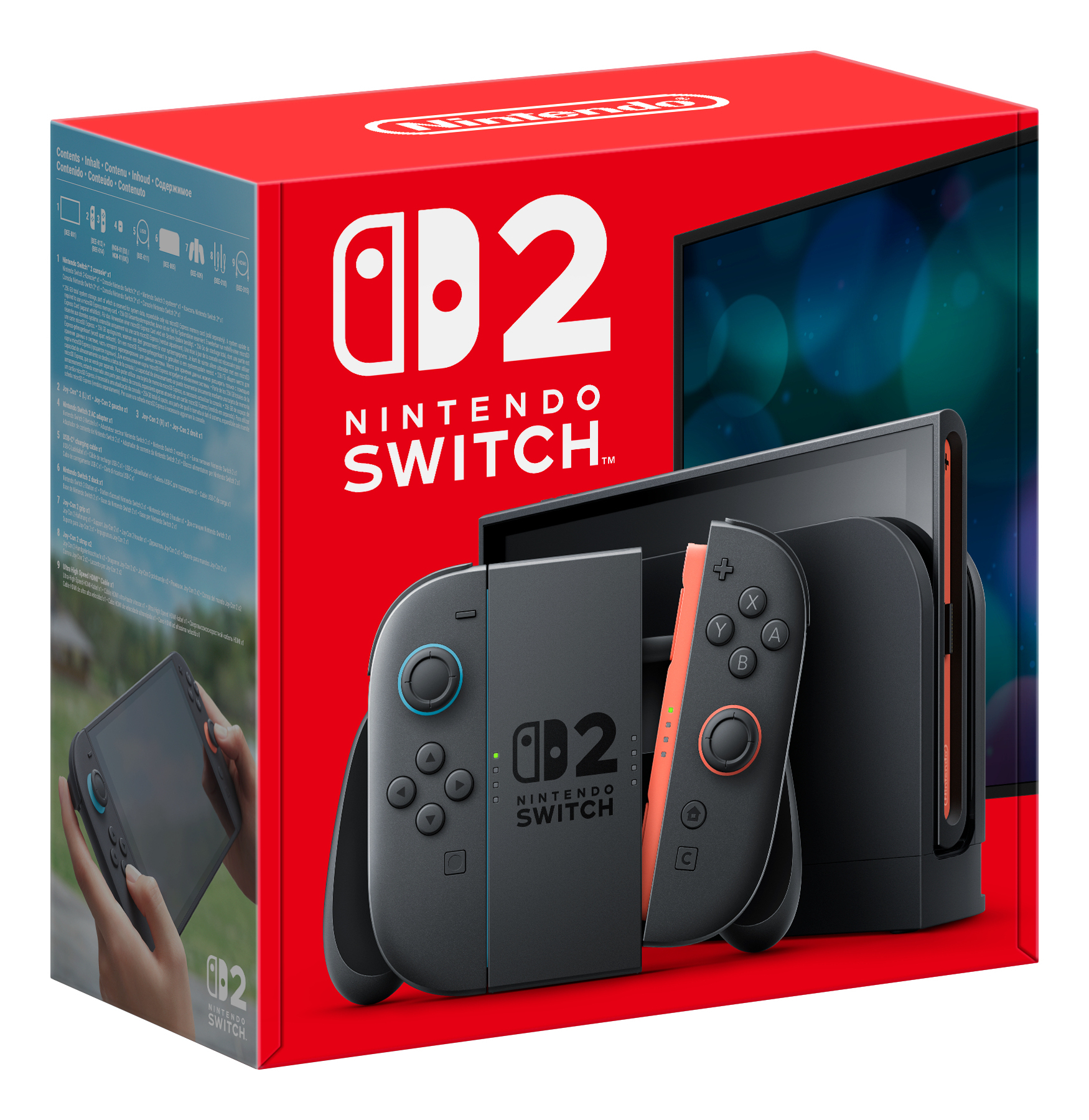 Nintendo Switch 2 Nintendo Switch 2. Platform: Nintendo Switch 2. Product colour: Black, Gaming control technology: Analogue / Digital, Gaming control function buttons: D-pad, Home button, Menu button, Power button. Display: LCD, Display diagonal: 20.1 cm (7.9"), Display resolution: 1920 x 1080 pixels. Storage media type: Flash, Built-in memory capacity: 256 GB, Compatible memory cards: MicroSD (TransFlash), MicroSDXC. Frequency band: 2.4 GHz, Wi-Fi standards: Wi-Fi 6 (802.11ax)
 -
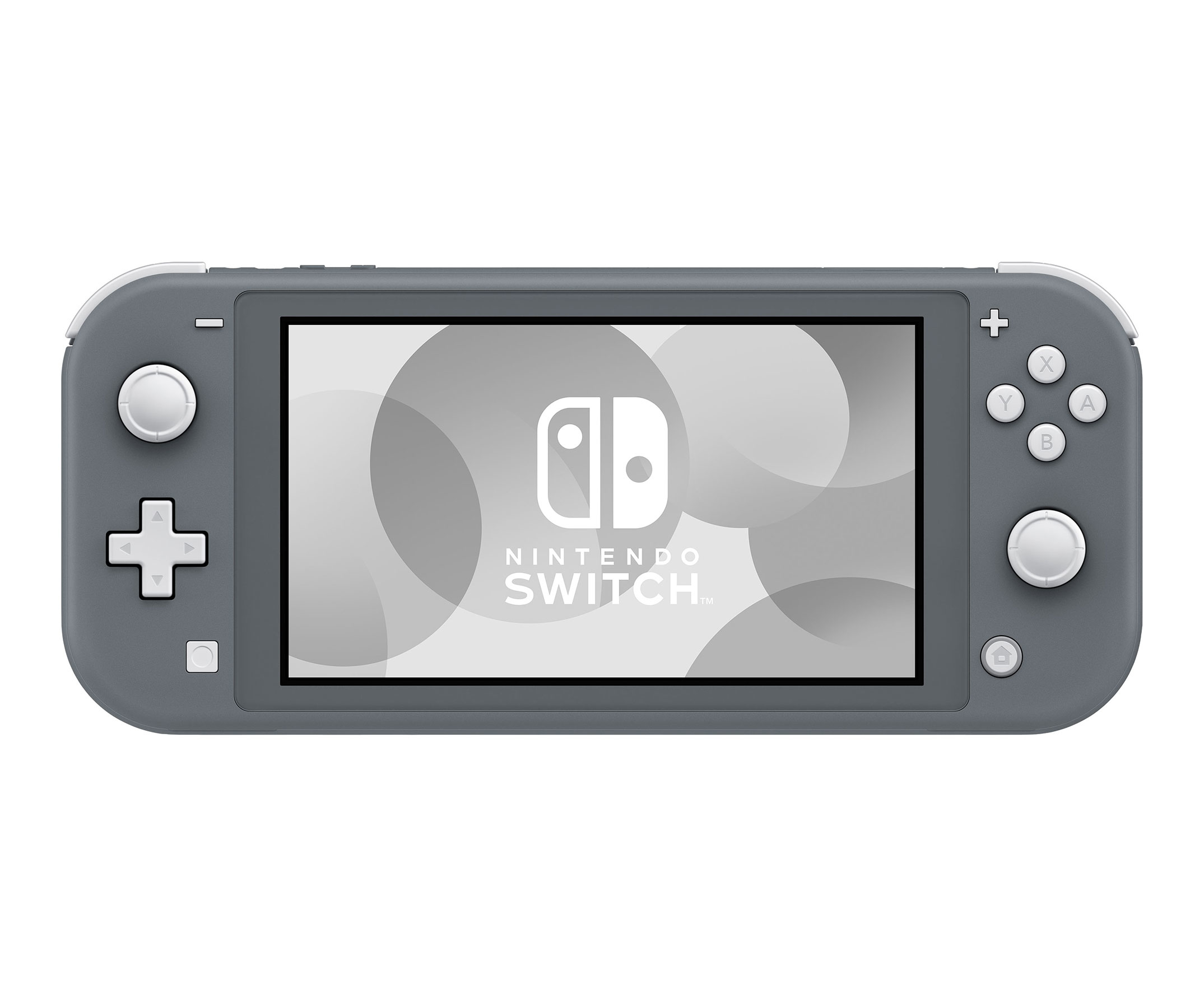 Nintendo Switch Lite Nintendo Switch Lite. Platform: Nintendo Switch, Processor frequency: 768 MHz. Product colour: Grey, Gaming control technology: Analogue / Digital, Gaming control function buttons: D-pad. Display: LCD, Display diagonal: 14 cm (5.5"), Display resolution: 1280 x 720 pixels. Built-in memory capacity: 32 GB, Compatible memory cards: MicroSD (TransFlash), MicroSDHC, MicroSDXC, Maximum memory card size: 2 TB. Wi-Fi standards: 802.11a, 802.11b, 802.11g, Wi-Fi 4 (802.11n), Wi-Fi 5 (802.11ac)
 -
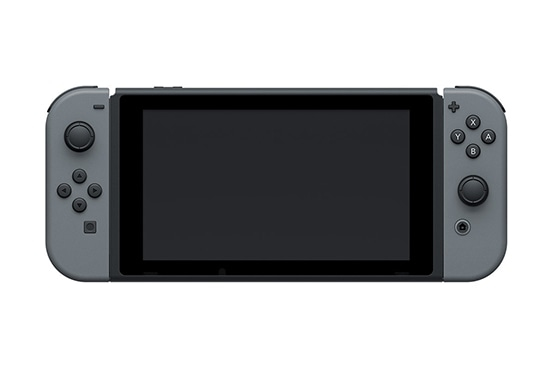 Nintendo Switch (OLED model) Nintendo Switch. Platform: Nintendo Switch, Processor frequency: 768 MHz, Internal memory: 4000 MB. Product colour: Grey, Gaming control technology: Analogue / Digital, Gaming control function buttons: D-pad. Display: LCD, Display diagonal: 15.8 cm (6.2"), Display resolution: 1280 x 720 pixels. Built-in memory capacity: 32 GB, Compatible memory cards: MicroSD (TransFlash), MicroSDHC, MicroSDXC, Maximum memory card size: 2 TB. Frequency band: 2.4/5 GHz, Wi-Fi standards: 802.11a, Wi-Fi 5 (802.11ac), 802.11b, 802.11g, Wi-Fi 4 (802.11n)
 - Nintendo Switch (v1) Nintendo Switch. Platform: Nintendo Switch, Processor frequency: 768 MHz, Internal memory: 4000 MB. Product colour: Grey, Gaming control technology: Analogue / Digital, Gaming control function buttons: D-pad. Display: LCD, Display diagonal: 15.8 cm (6.2"), Display resolution: 1280 x 720 pixels. Built-in memory capacity: 32 GB, Compatible memory cards: MicroSD (TransFlash), MicroSDHC, MicroSDXC, Maximum memory card size: 2 TB. Frequency band: 2.4/5 GHz, Wi-Fi standards: 802.11a, Wi-Fi 5 (802.11ac), 802.11b, 802.11g, Wi-Fi 4 (802.11n)